
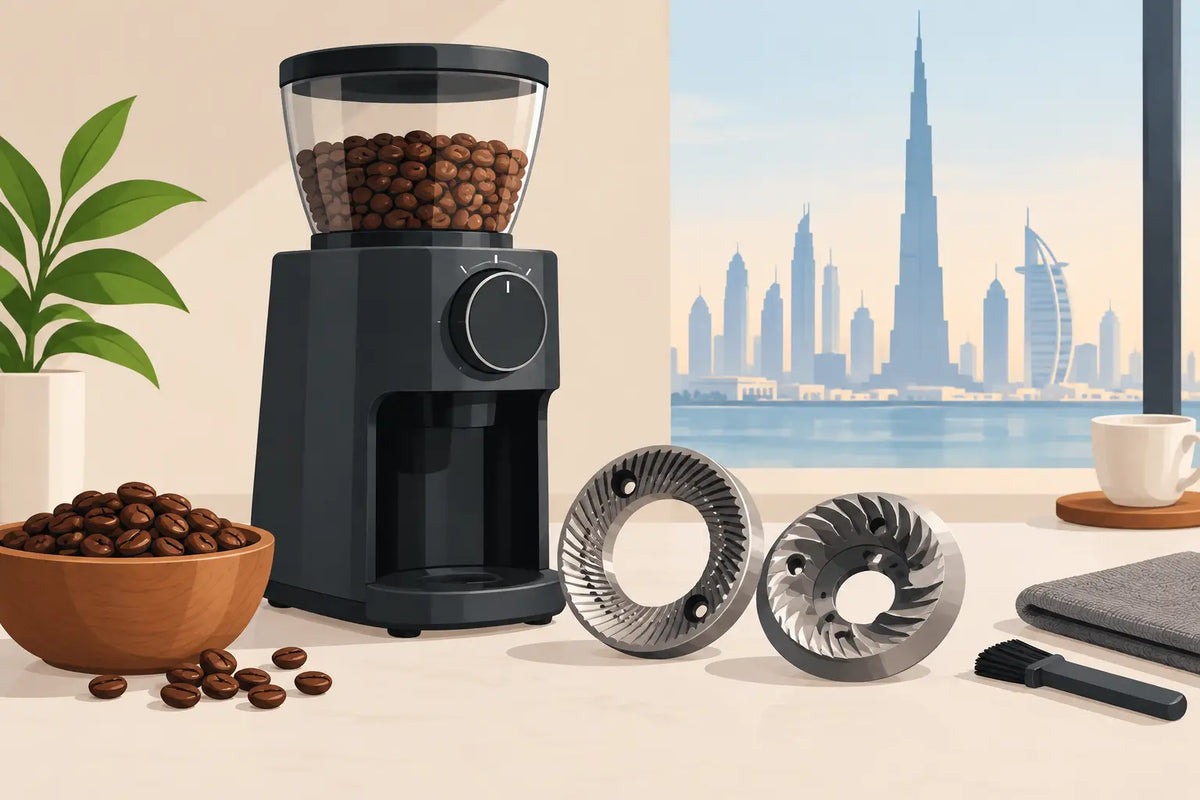
A grinder can still make noise, dispense grounds, and look perfectly clean while quietly undermining every espresso you pull. If shots have become slow one day and fast the next, the same setting no longer works, or coffee tastes flat despite fresh beans, coffee grinder burr replacement UAE may be the right next step. Burrs are the grinding surfaces that determine particle size and consistency. When they wear, the machine loses the precision that made it worth owning.
For a premium home grinder or a busy commercial unit, replacing burrs is not simply a matter of fitting two new metal parts. The correct burr set must match the model, its carrier, adjustment system, and intended grind range. Installation and calibration matter just as much.
What grinder burrs do to your coffee
Burr grinders crush coffee beans between two precisely machined surfaces. One burr may rotate while the other remains fixed, and the distance between them sets the grind size. Sharp, correctly aligned burrs produce a relatively even distribution of particles. That consistency helps water move through the coffee puck predictably.
As burr edges round off, beans are more likely to fracture rather than cut cleanly. The result can be a wider spread of fine powder and larger fragments. In espresso, this often appears as channeling, inconsistent shot times, bitter and sour flavors in the same cup, or a need to move the grinder much finer than usual. For filter coffee, it can mean a muddy bed, uneven drawdown, and less clarity in the cup.
Burr wear is gradual, so it is easy to blame a roast change, water, humidity, or dialing-in technique. Those factors do affect extraction, particularly in the UAE, where storage conditions can change quickly. But if performance continues to decline across different coffees, the grinder deserves closer inspection.
Signs coffee grinder burr replacement in the UAE is due
The most useful sign is not a specific number of bags or kilograms. Burr life depends on burr material, grinder design, roast level, cleaning habits, and how the grinder is used. A home espresso grinder used for two coffees a day will age very differently from a café grinder producing hundreds of doses each week.
Watch for a combination of practical changes. You may find that espresso takes longer to dial in and remains inconsistent after careful adjustment. A setting that was previously coarse may now be required for the same shot time. The grinder may produce more clumps, more visible fines, or noticeably less uniform grounds. Coffee can taste hollow, harsh, or unexpectedly weak even when the recipe is controlled.
A marked fall in output can also point to dull burrs, although it is not proof on its own. Retained grounds, a blocked chute, failing motor components, damaged adjustment threads, and poorly seated burrs can create similar symptoms. Grinding noise that has changed suddenly, a metallic rubbing sound, or a burr set that touches at an unexpected setting should be assessed before further use.
Do not confuse wear with a cleaning problem
Old coffee oils and compacted grounds can make a capable grinder perform badly. Before ordering replacement burrs, clean the hopper, burr chamber, chute, and grounds path according to the manufacturer’s instructions. Remove loose grounds with a suitable brush and use grinder cleaning products only where the manufacturer permits them.
Then return the burrs to their correct position, set a sensible starting point, and test with fresh beans. If the grinder recovers its consistency, replacement may not be necessary yet. If it remains difficult to dial in, inspection is the sensible next step.
Why compatibility matters more than burr shape alone
Flat and conical burrs are not interchangeable categories. Within each type, dimensions, mounting holes, rotation direction, tooth pattern, thickness, coating, and burr carrier design can differ. Two burr sets may appear almost identical and still be wrong for the grinder.
This is especially relevant for owners of Baratza, Sage, Breville, and Lelit equipment. Many models have dedicated replacement components, and some use different burr arrangements across closely related product generations. A part selected only by diameter or a product photo can fit poorly, rub against the opposing burr, or leave the grinder unable to reach espresso range.
The same caution applies to upgraded burrs. An alternative burr geometry may change the grinder’s taste profile, speed, and usable adjustment range. That can be a good choice for an experienced user who wants a particular style of espresso or filter coffee. It is not automatically an upgrade for every owner. A factory-spec burr set is usually the lower-risk option when the goal is dependable, familiar performance.
Burr replacement is also a calibration job
After burrs are fitted, the grinder often needs to be recalibrated. New burrs may sit slightly differently from worn ones, moving the true zero point and changing the usable range of the adjustment collar. On some grinders, shims or calibration adjustments are required to restore fine enough grinding for espresso without burr contact during normal use.
Fresh burrs can also need a short break-in period. Their edges settle through initial use, and settings may shift slightly during the first several doses. This is normal when installation is correct. Persistent rubbing, erratic adjustment, or inability to grind fine enough is not something to solve by forcing the dial finer.
When a professional inspection is the better choice
A confident owner may be able to replace accessible burrs on a straightforward domestic grinder, provided they have the exact compatible parts and follow the model-specific procedure. The trade-off is that a small assembly error can affect alignment and grind quality. Lost screws, damaged threads, displaced shims, or an incorrectly seated carrier can turn a parts job into a larger repair.
Professional service is the better route when the grinder has electronic controls, a difficult-to-access burr chamber, an uncertain fault, or signs of motor and adjustment problems. It is also advisable for commercial equipment, where downtime and inconsistent coffee have a direct operating cost.
A technician can distinguish worn burrs from other issues that imitate burr wear. They can inspect the carrier, adjustment mechanism, motor performance, switches, wiring, and grounds path, then fit compatible parts and test the grinder under operating conditions. This avoids replacing good burrs while leaving the actual fault unresolved.
Perfetto After Sales provides manufacturer-aligned repair support for specialist coffee equipment, with free collection and delivery across all seven UAE emirates. For owners who do not want to dismantle a premium grinder at home, collection, inspection, repair, and return offers a practical route back to consistent coffee. Typical repair turnaround is about three days, subject to diagnosis and parts availability.
Protecting new burrs after replacement
New burrs last longer when the grinder is treated as a precision component rather than a storage container for beans. Keep beans dry and avoid leaving flavored or exceptionally oily coffee in the hopper for extended periods. Empty and brush out the grinder regularly, especially around the chute and burr chamber where compacted grounds can affect retention and airflow.
Do not adjust a grinder aggressively against burr contact. If the adjustment feels unusually stiff or the burrs begin to chirp at a setting where they should not, stop and investigate the cause. For grinders that require adjustment while running, follow the manufacturer’s procedure rather than relying on a general rule from another model.
Commercial operators should make burr checks part of planned maintenance, not an emergency response to poor espresso. Recording the date of installation, estimated coffee volume, cleaning schedule, and dial-in changes makes wear easier to spot before service quality drops.
A better decision than replacing parts by guesswork
Burr replacement can restore a grinder’s speed, consistency, and ability to produce café-quality coffee, but only when worn burrs are genuinely the problem. Start with cleaning and controlled testing, then confirm the exact model and part compatibility before purchasing anything. If symptoms include noise, rubbing, unstable adjustment, or poor output after cleaning, arrange an inspection rather than forcing the grinder to keep working.
A well-maintained grinder gives every coffee bean a fair chance to perform. That is usually the most cost-effective place to start when the cup no longer tastes like it should.